CT Scans - Things to know

#1 Essential Guides
A CT (Computed Tomography) scan is sometimes called a CAT scan. It is an advanced imaging test that takes a series of X-rays from different angles around your body. A computer then stitches these images together to create detailed, 3D digital pictures of your internal organs, bones, and tissues.

During the procedure, you lie flat on a table that slides into a large, doughnut-shaped machine. It is quick, painless, and completely non-invasive. Often, you will be given a contrast dye. This can be a drink, an enema, or through an IV. This contrast acts like a highlighter to make specific organs, tissues, and blood vessels light up on the screen.

Contrast dye isn’t actually a dye that changes your internal color. It is a clear medical fluid, usually iodine for intravenous (IV) injections, or barium for drinks and enemas.

Sometimes, your radiology tech will forget to tell you that CT scans with contrast have effects that you should be aware of.

If your contrast is through an IV, you’re going to feel a hot flash, like a wave of heat starting in your face and spreading everywhere. When it gets to your groin, it will feel exactly like you just peed yourself. Seriously, don’t worry! Most everyone feels it, but you’re dry, I promise. You might also notice a weird metallic or coppery taste in your mouth. The whole strange feeling only lasts about 30 seconds, and then it’s totally gone. It’s all completely normal. Just hang tight!

If you drink your contrast, they will give it to you about an hour before your scan. It flavored to taste tolerable but it’s doubtful that you will like it. It likely will make you feel very full, bloated, or even slightly nauseous as it moves through your digestive tract.

Things to know:

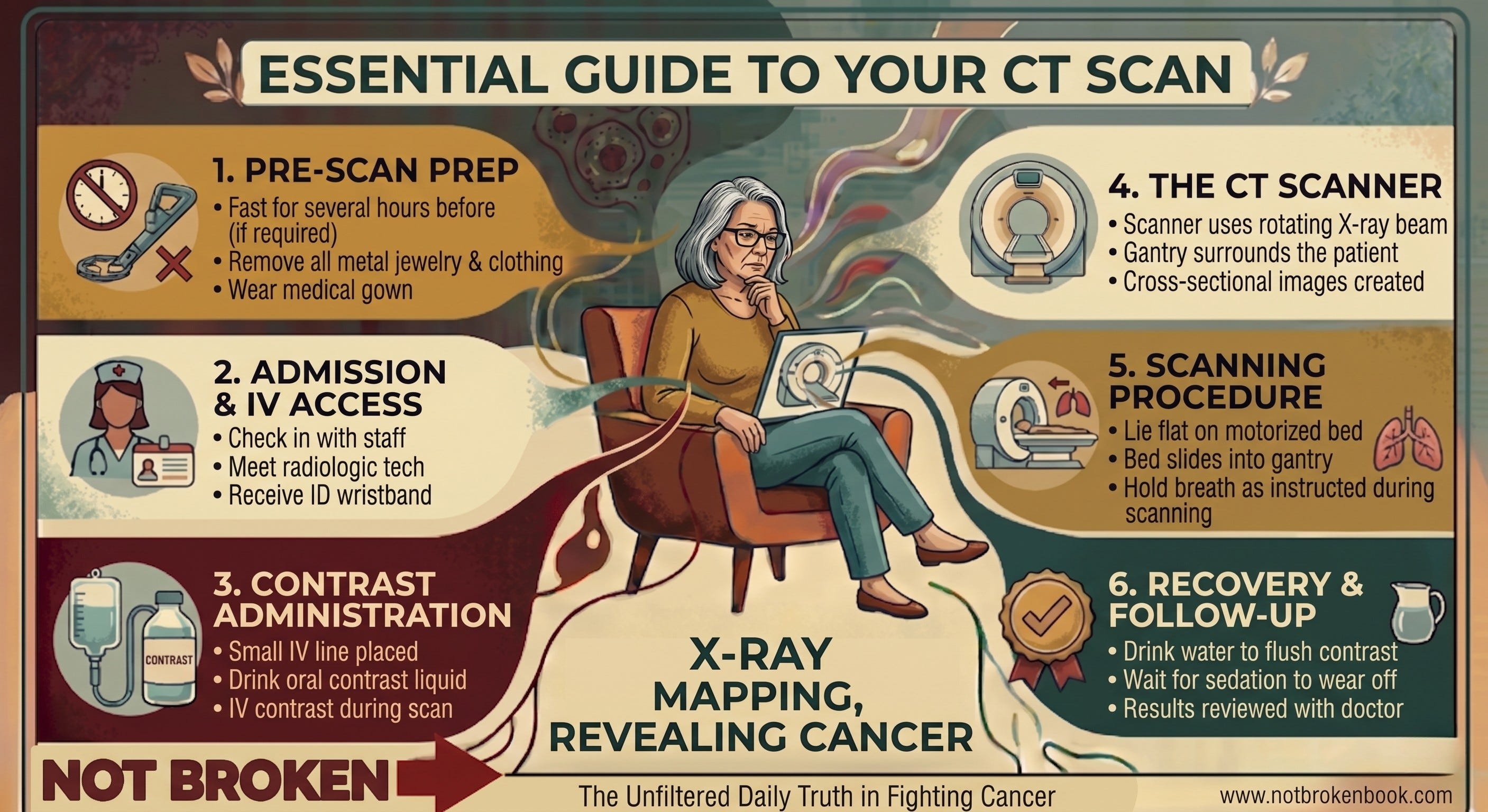
1. PREP

Fast for several hours before (if required)

Remove all metal jewelry and dentures

If you must remove any clothing, you will be given a medical gown

2. SCAN TIME

Receive ID wristband

Meet your radiologic tech

Small IV line placed

Drink oral contrast liquid and wait

Lie flat on motorized bed which slides into the scanner

They will push IV contrast through your IV during scan

Scanner uses rotating X-ray beam

You may need to hold breath if instructed during scanning

6. RECOVERY & FOLLOW-UP

Drink water to flush contrast

If you self-sedated, wait for sedation to wear off

Wait days for scan results and review with doctor

A CT scan is excellent at finding a mass and providing the “where” and “how big.” It cannot definitively tell you if that mass is cancer. Benign (non-cancerous) cysts and actual cancer tumors can sometimes look similar on a screen.

When your oncologist orders a CT scan, they are looking for anything that doesn’t belong, such as unusual growths, nodules, or irregular shapes. A CT scan can spot tumors as small as a few millimeters hidden deep inside the body.

If a tumor is found, the scan reveals its exact size and location. Doctors look closely at nearby lymph nodes and other organs to see if the cancer has spread (metastasized) from its original location.

During and after cancer treatment, follow-up scans show if the tumor is shrinking, growing, or if it has returned

Sometimes CT scans are used during surgery or a biopsy to guide the doctor for more precision. They can also be used for targeted radiation therapy, directly the radiation directly at the cancer while sparing healthy tissue.

___

If this article was helpful, my book, NOT BROKEN The Unfiltered Daily Truth in Fighting Cancer goes deeper into the day-to-day realities of cancer—honestly, practically, and without filters.

Read More Here → www.Amazon.com/dp/B0GT2G4S3D